Why Know Your Body Type
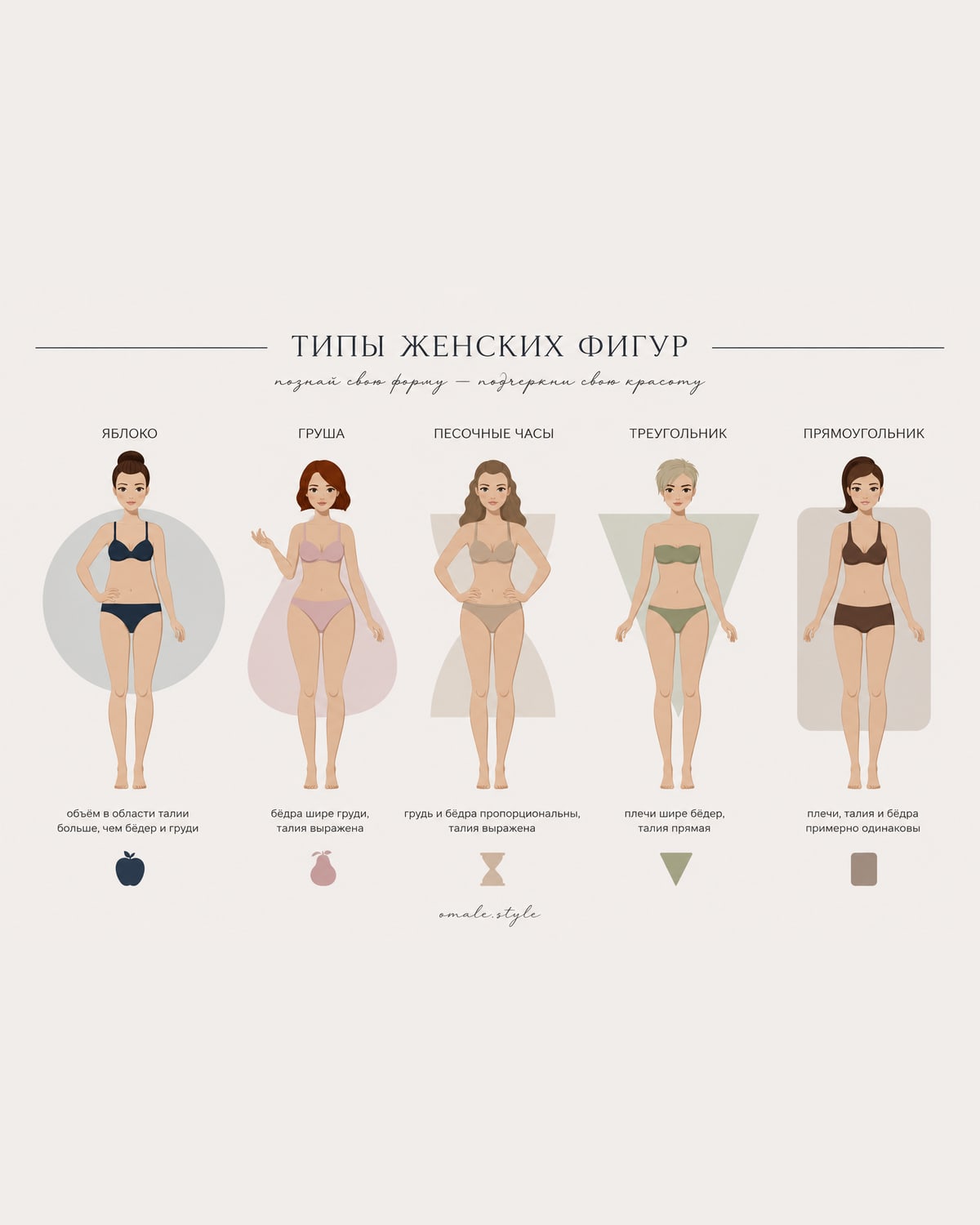
The base is built around your figure. And this is where something tightens inside many of us — because we have a bad history with the words "body type." Magazine quizzes. "Pear," "apple," "rectangle" — as if the very words were demeaning. And the eternal "play up your assets, hide your flaws" — as if the body had mistakes that need concealing.
I don't work within that frame. The body has no flaws. The body has proportions — and those are simply facts: what's wider, what's narrower, where the waist is, how tall you are. A body type isn't a judgment or a verdict. It's the input data by which the cut is chosen.
About myself I speak calmly: I'm short and I have a big belly. These aren't flaws — they're my inputs. Knowing them, I choose clothes I feel comfortable in and that I like myself in. I don't hide or disguise — I simply take the cut that works for my proportions.
For a long time I didn't know my real body type. At first I tried to determine it myself — from advice online, from measurements. I'll say right away: that doesn't work. By the measurements, I came out as an Hourglass.
A year later I went to a stylist. She determined my type quickly, without a real diagnostic — and confirmed it: Hourglass. She gave me recommendations for that type.
For the next nine-plus years I thought that was the truth. For an Hourglass, the advice is to emphasize the waist: waist-focused dresses, belts. And that's what I did. The recommendations didn't help — on the contrary, they made shopping harder: nothing fit. And I thought the reason was me — just too fat.
But during my style training I finally did a full diagnostic and determined my real type — Apple. The recommendations for it turned out to be the opposite. Not to emphasize the waist, but to choose looser. Not a fitted cut, but a straight one. The accent — on slim legs. A whole new world opened up for me.
The store stopped being a lottery. For the first time I clearly saw: this is mine, and over there I don't even look. There were fewer random purchases, and my clothes finally began to go together — because they were all chosen for one body. Mine.
And here's what becomes clear about "it doesn't fit." Remember the circle from the first part — "nothing fits me, so I must be fat"? Most often a piece fits badly not because something is wrong with your body, but because the cut isn't for your proportions. The same piece will fit on a different figure — and a different piece will fit on you. It's not about "better" and "worse." It's about compatibility.
What knowing your type gives you in practice. Money: you stop buying what looks beautiful on the hanger but won't fit you. Time: in the store you immediately see what to try on and what to walk past. And peace of mind: the fitting room stops being a place where you scold yourself.
I'm not going to set up a textbook on body types here, with tables and measurements — that's a topic for separate, detailed work. Especially since you've already seen from my story: neither online measurements nor a quick verdict without a diagnostic give you accuracy. What matters here is something else — changing the frame. Not "what do I hide," but "what are my proportions and what cut works for them."
And if you want to determine your type precisely, write to me. Book a consultation on my site omale.style or send me a direct message on Instagram @malkovastylist — we'll work through your proportions together.
When this knowledge appears, the base stops being an abstraction. The "base trousers" from the list turn into specific trousers of a specific cut — the ones that fit you. And beyond that, the base has one more dimension — color.